Key takeaways
- A rain barrel stores roof water for the garden; a rain garden soaks runoff into the ground. Together they keep pollutants out of storm drains.
- One inch of rain on 1,000 square feet of roof produces roughly 620 gallons of water, so a single barrel fills fast. Plan for overflow.
- Site a rain garden at least 10 feet from the foundation, on a slope under about 12 percent, and call Diggers Hotline before you dig.
- Size it with a simple soil test and the Wisconsin DNR’s size factors; most home rain gardens fall between 100 and 300 square feet.
- Use deep-rooted Wisconsin native plants, and winterize your rain barrel before hard freezes.
On a typical Fox Valley lot, rain hits the roof, pours out of the downspouts, runs across the driveway and drops into the street. Within minutes it is in a storm drain headed for a creek, the Fox River or Lake Winnebago, carrying whatever it picked up along the way. Rain barrels and rain gardens interrupt that trip. They are two of the most satisfying weekend projects a homeowner can take on: inexpensive, good-looking when done well, and directly connected to the health of the waters we fish, paddle and swim in.
This guide walks through both, with the sizing method from the Wisconsin DNR and UW Extension homeowner manual and plant choices suited to northeast Wisconsin. For the bigger picture of why runoff matters here, see our article on protecting the Fox River and Lake Winnebago.
Rain barrel or rain garden?
They do different jobs, and many households end up with both.
| Rain barrel | Rain garden | |
|---|---|---|
| What it does | Stores roof water for later use | Soaks runoff into the soil within about a day |
| Capacity | Usually 50 to 80 gallons per barrel | Handles runoff from a roof section or driveway, often hundreds of gallons per storm |
| Cost | Low | Low to moderate (mostly plants and your labor) |
| Time to set up | An hour or two | A weekend or two |
| Season | Spring through fall; must be winterized | Works year-round once established; thrives on spring melt |
| Bonus | Free, unchlorinated water for plants | Pollinator habitat and a beautiful planting bed |
Rain barrels: setup, use and winter care
How much water are we talking about?
The math is simple and eye-opening. One inch of rain falling on one square foot of roof equals about 0.62 gallons. That means one inch on a 1,000-square-foot roof produces roughly 620 gallons. A single downspout often drains a few hundred square feet, so a 55-gallon barrel can fill during the first quarter inch of a storm. A barrel will not capture everything, which is why the overflow matters as much as the barrel itself.
Setting up a rain barrel
- Choose the downspout. Pick one near the garden beds you water most, on level ground, and away from the driveway if possible.
- Build a stable base. A full 55-gallon barrel weighs more than 450 pounds. Set it on solid concrete blocks or a compacted gravel pad, raised high enough to fit a watering can under the spigot.
- Cut and divert the downspout. Shorten the downspout above the barrel and add a flexible elbow, or install a diverter kit that sends water into the barrel and back down the spout when the barrel is full.
- Screen the inlet. Make sure the opening has fine mesh to keep out leaves and mosquitoes. Keep a lid on tight.
- Plan the overflow. Attach a hose to the overflow fitting and run it at least several feet from the foundation onto lawn, a planting bed or into a rain garden.
- Use the water. An empty barrel is a working barrel. Water plants between storms so there is room for the next rain.
Using the water safely
Rain barrel water is excellent for flowers, shrubs, trees, lawns and container plants. For vegetables, apply it to the soil rather than over leaves, avoid using it on leafy crops right before harvest, and wash produce well, since roof runoff can carry bird droppings and particles from roofing. Never drink it or use it for cooking.
Mosquitoes
Mosquitoes need standing water for about a week to develop. A tight lid, a fine screen over the inlet and regular use of the water prevent problems. Check screens after storms for gaps or debris.
Winterizing in the Fox Valley
Water expands when it freezes and can split plastic barrels and fittings. Before nights start freezing regularly, usually by late October or early November here, drain the barrel completely, disconnect it, and store it upside down or in a garage. Reattach a downspout extension so winter thaws and spring melt drain well away from your foundation. Reinstall the barrel in spring once hard freezes are past.
Rain gardens: choosing the right spot
A rain garden is a shallow, flat-bottomed depression planted with deep-rooted plants that receives runoff from a roof, driveway or lawn and lets it soak in. According to the Wisconsin DNR, rain gardens capture about 30 percent more water than a conventional lawn. Location is the most important decision.
- At least 10 feet from the foundation, so infiltrating water does not move toward your basement.
- On a gentle slope. If your lawn slopes more than about 12 percent, look for another site or consult a professional.
- Not where water already ponds for days. Persistent puddles signal compacted or very poorly draining soil. A rain garden needs soil that drains.
- Away from septic systems, wells and utility lines. Contact Diggers Hotline (dial 811) at least three business days before digging. The service is free.
- In full or partial sun for the widest plant choices, and not directly under large trees whose roots will compete.
- Where you can enjoy it. A rain garden near the front walk gets noticed and maintained.
Test your soil first
Much of the Fox Valley sits on clay or clay loam, though sandier soils occur in places. Soil type determines how big your garden needs to be, so do two quick tests.
The ribbon test
Moisten a handful of soil from about six inches down and squeeze it into a ball, then press it between thumb and finger to form a ribbon. Sandy soil will not hold a ball. Silty soil forms a ribbon shorter than an inch before breaking. Clayey soil forms a ribbon of one to two inches. If the ribbon runs longer than two inches, the soil is likely too heavy for a rain garden without major amendment.
The percolation test
Dig a hole 6 to 12 inches deep where the garden will go, fill it with water and let it soak for an hour. Refill it and measure how far the water drops over the next hour. A drop of more than half an inch indicates a workable site.
Sizing your rain garden
Step 1: Pick a depth
Depth depends on your lawn’s slope. Measure the drop over 15 feet with a string, line level and stakes, then divide the drop by the length.
- Slope under 4 percent: 3 to 5 inches deep
- Slope of 5 to 7 percent: 6 to 7 inches deep
- Slope of 8 to 12 percent: about 8 inches deep
Step 2: Find the drainage area
For a roof-fed garden, estimate the roof area that drains to the downspout you will use. A quick method: measure the footprint of that section of the house and adjust for overhangs.
Step 3: Multiply by the size factor
The homeowner manual from the Wisconsin DNR and UW Extension provides these size factors for gardens less than 30 feet from the downspout:
| Soil type | 3 to 5 in. deep | 6 to 7 in. deep | 8 in. deep |
|---|---|---|---|
| Sandy | 0.19 | 0.15 | 0.08 |
| Silty | 0.34 | 0.25 | 0.16 |
| Clayey | 0.43 | 0.32 | 0.20 |
For gardens 30 feet or more from the downspout, where water has already soaked in along the way, the factors drop to 0.03 for sandy, 0.06 for silty and 0.10 for clayey soil.
A worked example
Say 400 square feet of roof drains to a downspout, your garden will sit 15 feet away, the lawn slopes 3 percent and the ribbon test says clay. Choose a depth of 3 to 5 inches, use a factor of 0.43, and multiply: 400 times 0.43 equals 172 square feet, or roughly 8 by 22 feet. Gardens between 100 and 300 square feet are typical; above 300, it is usually easier to build two smaller gardens.
Building a rain garden step by step
- Call 811 and lay it out. After utilities are marked, outline the garden with rope or a hose. A long, crescent or kidney shape perpendicular to the slope catches water best.
- Remove the turf. Strip sod with a flat spade or sod cutter. Use it to build the berm or flip it upside down elsewhere to compost.
- Dig to depth and level the bottom. Dig to your target depth, keeping the bottom as flat as possible so water spreads evenly. On a slope you will dig more on the uphill side and use that soil on the downhill side.
- Build the berm. Use excavated soil to form a low, compacted berm along the downhill edge and sides, then cover it with mulch or turf so it does not erode.
- Improve heavy soil. In clay, loosen the bottom deeply and work in compost. Do not add sand to clay alone, which can make it set like concrete.
- Connect the water. Run a buried pipe, a grassy swale or a stone-lined channel from the downspout to the garden, and armor the inlet with stone so it does not wash out.
- Plant closely. Set plants roughly a foot apart, wettest-tolerant species in the center and drier-tolerant ones on the edges.
- Mulch and water. Spread two to three inches of shredded hardwood mulch, which stays put better than chips in a flooding basin. Water plants weekly until established.
Native plants for northeast Wisconsin rain gardens
Native plants are the heart of a rain garden. Their deep roots open channels in clay soil, they tolerate both soggy springs and dry Augusts, and they feed pollinators. The center of the garden gets wet most often; the edges stay drier.
| Plant | Zone in garden | Approx. bloom | Notes |
|---|---|---|---|
| Blue flag iris | Center | June | Handles standing water well |
| Swamp milkweed | Center | July to August | Monarch host plant |
| Joe-Pye weed | Center or back | July to September | Tall; plant where it will not block views |
| Blue vervain | Center | July to September | Upright purple spikes |
| Cardinal flower | Center | August to September | Hummingbird favorite |
| Great blue lobelia | Center to middle | August to September | Tolerates some shade |
| Fox sedge | Center to middle | Early summer | Grass-like; holds soil |
| Golden alexanders | Middle | May to June | Early-season pollinator food |
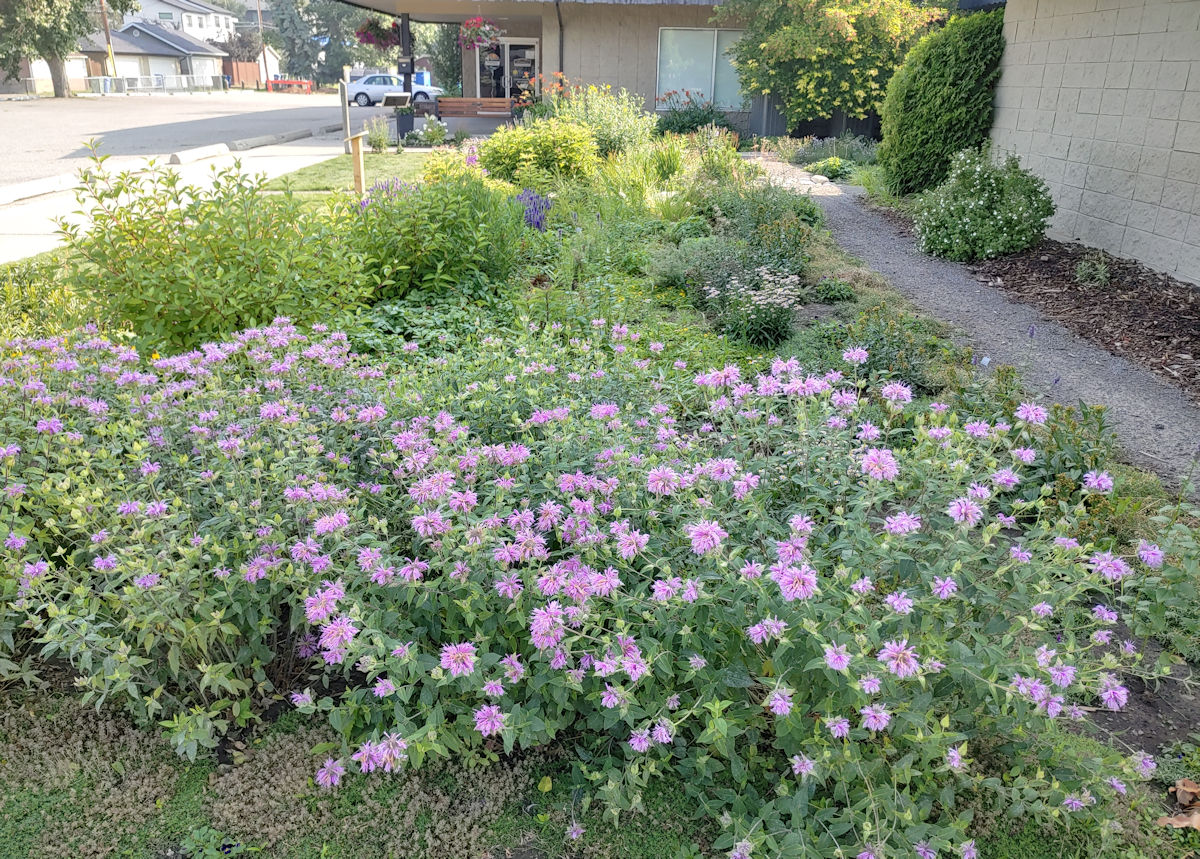
| Wild bergamot | Middle to edge | July to August | Fragrant leaves, bee magnet |
| New England aster | Middle to edge | September to October | Critical late-season nectar |
| Black-eyed Susan | Edge | June to September | Fast to establish |
| Prairie dropseed | Edge | Late summer | Neat, fine-textured grass |
Buy from nurseries that sell straight species grown from regional seed where possible, and avoid invasive plants such as purple loosestrife and reed canary grass. For more on building a native landscape, see Native Plants and Pollinators: Rewilding Your Wisconsin Yard.
Care and maintenance
The first two years
Water weekly in dry spells, pull weeds every couple of weeks and replace any plants that fail. Native perennials often “sleep” the first year, building roots, then “creep” the second year and “leap” in the third.
Ongoing
- Check the inlet after big storms and clear any sediment or leaves.
- Top up mulch in spring as needed until plants fill in.
- Leave seed heads and stems standing over winter for birds and insects, then cut back in spring once daytime temperatures are consistently warm.
- If water stands for more than a couple of days, loosen the soil and add compost, or plant more deep-rooted species.
Local credits and support
Several Fox Valley communities fund stormwater management through a stormwater utility fee on property bills. Some, including Appleton and Oshkosh, have published residential credit policies that recognize practices like rain barrels and rain gardens. Program terms, credit amounts and paperwork change, so check your city’s stormwater utility page or call public works before you build. Your county land and water conservation department and UW-Madison Extension office are also good sources for local plant and soil advice.
Next steps
- Get started this weekend with our 55-gallon Rain Barrel Kit.
- Learn why these projects matter in Protecting the Fox River and Lake Winnebago.
- Make it a block project: our study circles page shows how neighbors can plan and build together.
Frequently asked questions
Will a rain garden create a mosquito problem?
No. A properly sized rain garden drains within about a day after most storms, and mosquitoes need several days of standing water to complete their life cycle. If water stands much longer, the soil is not draining well and the garden needs a soil fix or a different location.
How far from my house should a rain garden be?
Wisconsin’s homeowner rain garden manual recommends placing it at least 10 feet from your foundation so infiltrating water does not seep toward the basement. Also keep it away from septic systems, and contact Diggers Hotline at least three business days before you dig.
Can I use rain barrel water on my vegetable garden?
Many gardeners do, with precautions. Roof runoff can pick up bird droppings and material from roofing, so apply it to the soil rather than over leaves, avoid using it on crops right before harvest, and wash produce well. For drinking or cooking, never use untreated rain barrel water.
When should I winterize a rain barrel in the Fox Valley?
Before nights start freezing regularly, usually by late October or early November. Drain it completely, disconnect it, store it upside down or indoors, and reattach your downspout extension so winter melt water still flows away from your foundation.
Do Fox Cities municipalities offer credits for rain gardens or rain barrels?
Some local stormwater utilities, including Appleton and Oshkosh, have published residential credit policies covering practices such as rain barrels and rain gardens. Terms, amounts and paperwork change over time, so check your city’s current stormwater utility page before you build.